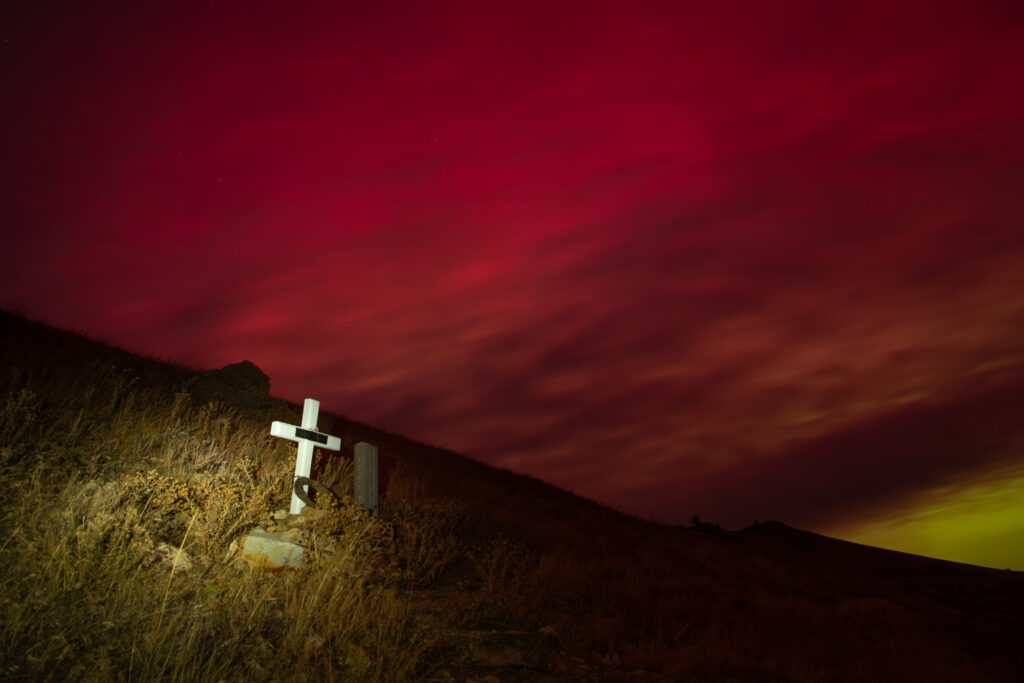
The aurora borealis illuminates the sky behind Eldon Diettert’s cross in Mann Gulch on November 11, 2025.
Story by Kairi Lising & Henry Doellinger // Photos by Henry Doellinger
“They were still so young that they hadn’t learned to count the odds and to sense they might owe the universe a tragedy.”
– Norman Maclean, Young Men and Fire
Taylor Moe’s first trip into Mann Gulch was hell.
The hike was more than two hours long, camera equipment feeling heavier and heavier with each step on the switchback trail. The documentary film crew was hiking in the peak of summer heat at 100 degrees Fahrenheit.
“We’re getting our asses kicked by this hike,” Moe said.
Moe, his wife and executive producer Shannon Carlstrom and his best friend, cinematographer Dashiell Pare-Mayer wove their way through forest and tall grass, to the place that had haunted Moe’s thoughts for a decade.
Moe was cruising the backroads of his high school hometown of Seattle when he heard the song “Cold Missouri Waters” by James Keelaghan, a folk retelling of the Mann Gulch fire. He became obsessed with the story of the 13 young men who died there.
“It all plays out like a drama, a Greek tragedy,” Moe said.
He read and re-read Norman Maclean’s Young Men and Fire, the scientific yet prosaic book about the events at Mann Gulch. Moe graduated film school with Mann Gulch still on his mind, realizing a documentary film could turn his passion into a medium that could speak true to the tragedy.
“There was nothing in the universe now but the terminal glare of the Missouri, an amphitheater of stone erected by geology.”
– Norman Maclean, Young Men and Fire
The Mann Gulch fire erupted after a lightning storm in western Montana in the Helena National Forest on August 5, 1949. The fire burned around 5,000 acres and claimed the lives of 13 young smokejumpers. That singular event changed firefighting practices practically overnight and remains an important chapter in the book of wildland firefighting.
A number of small fires started in what is now the Gates of the Mountains Wilderness, a windswept region of rough rock and forested slopes along the Missouri River 20 miles north of Helena. Just south of Mann Gulch, a blaze spread, corralled by the hills and wind. A crew of smokejumpers was dispatched to do battle with the flames. Fifteen firefighters answered the call, ranging from 17 to 33 years old and from across the U.S. They were well trained, proud of their elite status as smokejumpers and full of youthful adrenaline.
Smokejumping was a young concept in 1949. The first fire jump happened nine years prior, into Montana’s Nez Perce National Forest. After the Big Burn in 1910, the Forest Service followed the 10 a.m. Rule, a policy to contain all wildfires by 10 a.m. the morning after they were reported.
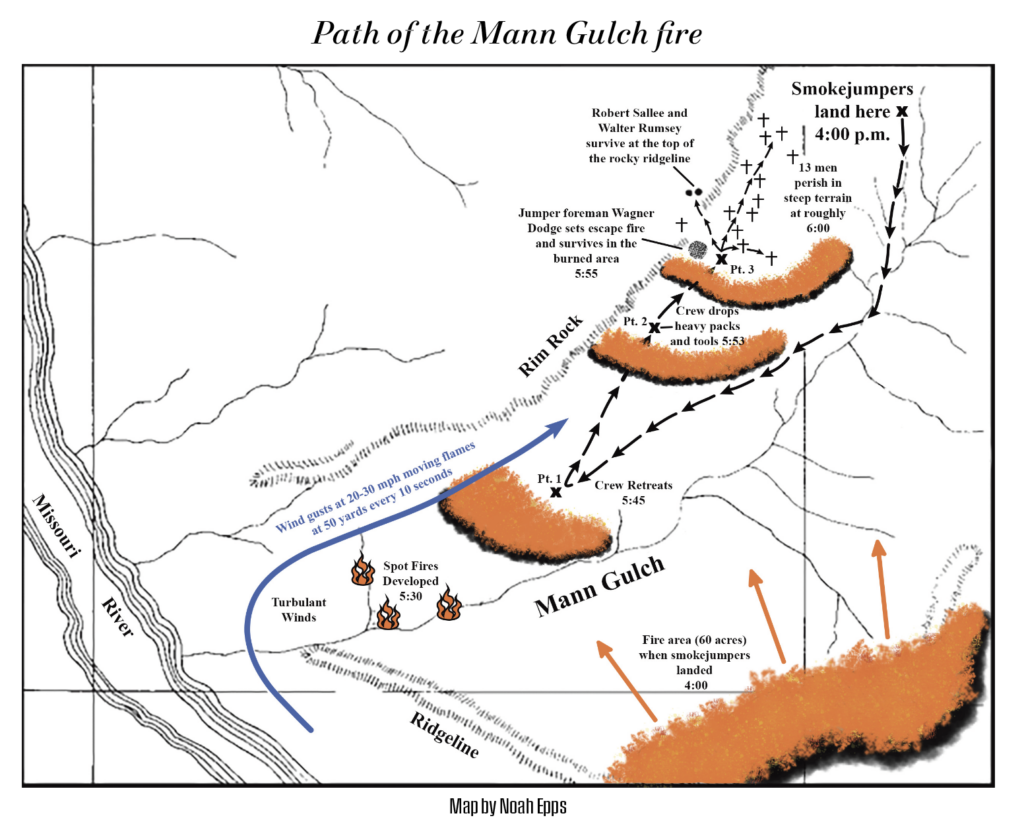
The smokejumpers parachuted into the Helena National Forest about half a mile from the fire’s shifting perimeter to their south. When they landed around 4 p.m. the fire measured 60 acres.
Former smokejumper turned fire guard, James O. Harrison was already on scene, and met the smokejumpers soon after they landed on the northeast slope of the gulch. The 20-year-old had resigned from aerial firefighting just the year before. His mother thought it was too dangerous. The Mann Gulch fire looked, on paper, no different than many others they’d fought that season. None of the men knew they were headed toward disaster.
“… a colossal blowup but shaped by little screwups that fitted together tighter and tighter until all became one and the same thing — the fateful blowup.”
– Norman Maclean, Young Men and Fire
When Foreman R. Wagner “Wag” Dodge prepared to lead his crew toward the fire, he found it had grown and was moving rapidly toward them. He ordered the crew back up the gulch, toward their landing zone.
Fifty-foot flames shot up the gulch’s steep walls and the men realized they were trapped. The blaze was moving 50 yards every ten seconds and was racing up the incline.
Despite dropping unnecessary gear and running, the fire gained on the crew. Realizing the odds were against them, Dodge instinctively lit a second fire, burning the grass and scrub in front of him. He laid face down in the scorched dirt and rock as the fire raged around the fuel-less patch of black.
Walter Rumsey and Robert Sallee had been at the back of the group, the least experienced of the crew. When they turned to flee, they were in the lead and made it to the safety of a rocky ridgeline to the north, before flames engulfed the gulch.
Eleven men died during the blaze in Mann Gulch and two more in the hospital the next day. The pocketwatch Harrison carried had melted, its hands cemented at 5:58 p.m.
The public outcry was enormous. Thirteen young and vibrant men, their lives extinguished in a matter of moments, and for what. Prior to Mann Gulch, no smokejumper had ever died fighting a wildfire.
It is unknown why the other smokejumpers didn’t follow Dodge’s lead in setting what’s now known as an escape fire; the wind and fire were loud and communication was difficult in the chaos. Dodge’s fire technique was the genesis of a now widely-taught, last-resort tactic and the events of that day brought changes to training for all wildland firefighters.
Word of what happened at Mann Gulch spread quickly among firefighting ranks. However, it took eight years before the Forest Service officially added the 10 Firefighting Orders into firefighter training programs.
Some of those orders spoke directly to what went wrong in 1949. “Identify escape routes and safety zones and make them known.” “Post lookouts when there is possible danger.” “Maintain prompt communication with your forces, your supervisor and adjoining forces.”
The Forest Service also issued 18 Fire Watch Out Situations in 1957, including when there’s unburned fuel between personnel and fire, a change in wind speed or direction and when safety zones and escape routes are not clearly identified.
“… at the end of this tragedy, where nothing much was left of the elite who came from the sky, but courage struggling for oxygen …”
– Norman Maclean, Young Men and Fire
In 2024, the film crew attended events memorializing the 75th anniversary of the Mann Gulch fire. To a gathered crowd in Helena, James Keelaghan sang an acoustic version of “Cold Missouri Waters,” the song that sparked Taylor Moe’s obsession back in high school.
Moe saw John Maclean, Norman’s son, at the 75th event. John brought Young Men and Fire to publication in 1992, two years after his father’s death and 43 years after the Mann Gulch catastrophe. The book landed on the New York Times bestseller list and stayed there for 14 weeks.
John was preparing to talk on the granite steps of Helena’s Capitol, surprised when he saw people filling row after row of folding chairs. They didn’t all look like Forest Service workers. He stopped an organizer who said the crowd included many family members of those who died on that fateful day in August of 1949.
“These people weren’t even alive then,” John said. “They are the real legacy of Mann Gulch.”
John said he was humbled to speak before the group about the lasting impacts of Mann Gulch. “Fatal wildland fires do not die out when the last ember is extinguished. Those who lived on in the twilight of the Mann Gulch fire — the families, friends and fellow smokejumpers of those who died, and a sympathetic public continued to feel its lingering effects.”
“The nearest anyone can come to finding himself at any given age is to find a story that somehow tells him about himself.”
– Norman Maclean, Young Men and Fire
Two Helena middle school teachers were also in the folding chairs at the 75th anniversary services.
Shannon Thomas and Dick McMahon had been teaching about Mann Gulch for more than 30 years at C.R. Anderson Middle School. The teachers used Young Men and Fire as a touch point for their interdisciplinary studies curriculum. In English class, students read and discussed the book. In math class, they calculated the slope of Mann Gulch’s mountainside. In science, students studied fire behavior. In history class, the curriculum compared firefighting efforts pre- and post- Mann Gulch. Students knew that at the end of the year, they’d get to go to Mann Gulch and see the scene for themselves.
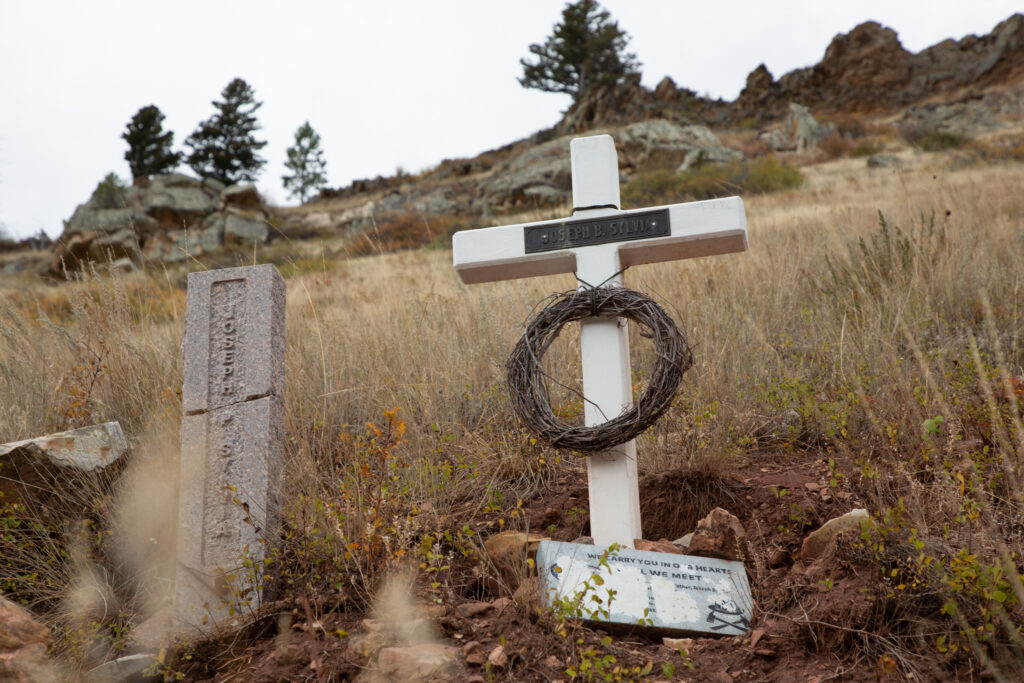
Students would bring little offerings to place on the crosses, like coins, pins and dried flowers. They made pencil rubbings of the crosses’ plaques, some focusing in on one smokejumper. But the mood is not somber when the children make their trek to Mann Gulch each year. They can’t wait to explore the far reaches of the mountainside to find each and every memorial. “Oh my God, just pell-mell down the hills. It’s just one of those, you know, amazing, amazing educational moments to think back on,” Thomas said.
Thomas and McMahon say the tale of Mann Gulch resonates with their students year after year. The filmmakers spoke to some of those middle school students at the 75th memorial, several felt particularly drawn to 19-year-old fallen smokejumper Eldon Diettert.
The filmmakers also connected to Diettert’s story the most. “He’s the Missoula boy,” Moe said. Diettert was called to Mann Gulch from his birthday dinner in Missoula, dying the same day he turned 19. Diettert’s descendants showed Moe what Eldon had left behind. In a box, Moe found slides and undeveloped film from Diettert’s camera. Moe developed the film and found photos of a goofy teenage boy whose life was cut short that day.
“He was just a kid. He reminded me of my own kid who is around the same age he was when he died,” cinematographer Pare-Mayer said.
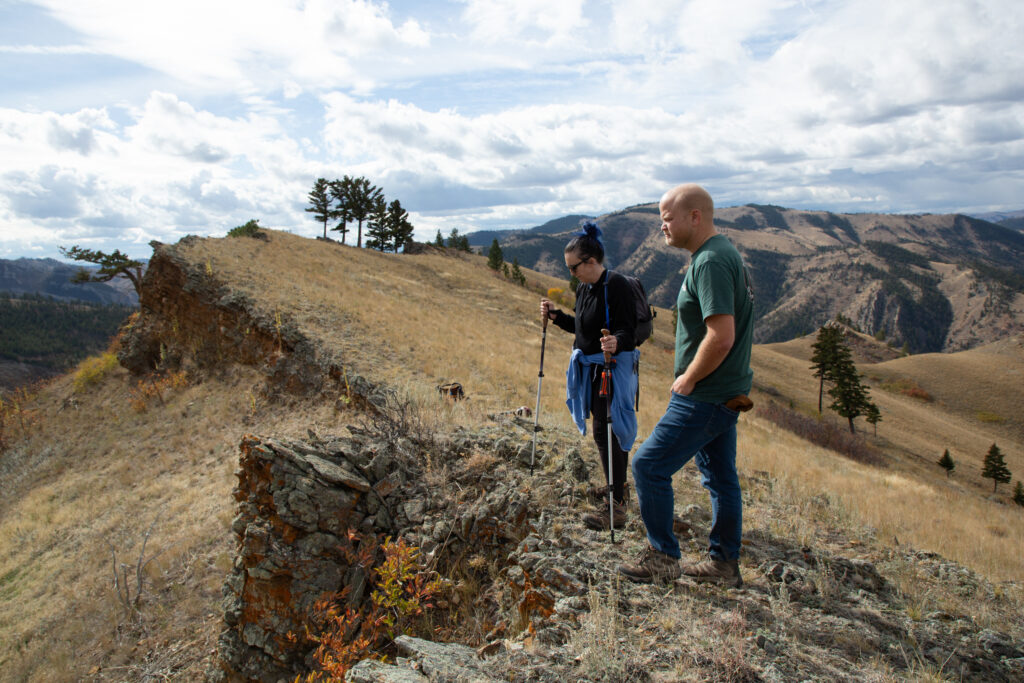
Moe, his wife and best friend Pare-Mayer have almost reached the threshold to Mann Gulch. Marked simply by a wooden post, the overlook stands as the gateway to the scene Moe has long tried to envision. It’s suddenly silent. Moe hears himself swallow. No more wind. Not even a bird chirping. And there it is, Mann Gulch laid out before them and just as Maclean described it. They imagine that day, the chaos and confusion, the terror and death.
“Why did they have to fight this fire? There’s nothing here,” Moe said. “Nothing worth dying for. It’s a bitter feeling.”
Moe named his film “13 Crosses,” for the memorials sprinkled high and low through Mann Gulch, marking the lonely spot where each man fell. The crew takes a moment, gathers their thoughts and camera gear, and begins the trek to the deep amphitheater that bore witness to the last moments of beloved young men.
“… often the best we can do with catastrophes, even our own, is to find out exactly what happened and restore some of the missing parts.”
– Norman Maclean, Young Men and Fire
Epilogue
The tragedy at Mann Gulch changed the way we saw fire. That day proved we weren’t invincible, when our best and brightest fell at the whim of the wind.
Events like the tragedies at Mann Gulch and the Big Burn have shaped firefighting policy through the decades. Forest Service policies have changed to prioritize protecting man-made structures and human life, often prompted by untimely deaths.
The lesson, that fire cannot be controlled, came at a cost. Researchers have worked to deepen their understanding surrounding fire behavior, managing fuels and making fire a part of living instead of trying to banish it from the landscape.
The Forest Service website now says, “we still suppress fires, especially if they threaten people and communities, but we understand that fire has a role in nature.”
As the world grows warmer, these lessons will be reinforced as more fires and more intense blazes are predicted in the years to come. Our losses will be greater as humans encroach into our once-wild lands, building homes where fire is known to rule.
The legacy of our losses lives on in the memories of family and school children, in song, in film and in firefighters around the world. Living in the West means being touched by wildfire in one way or another, lives and landscapes forever shaped by the forces of nature.
“The stars came out. The great Missouri passing below repeated the same succession of chords it probably will play for a million years to come.”– Norman Maclean, Young Men and Fire