Nowhere to Hide
Uncovering the health impacts of wildfire smoke
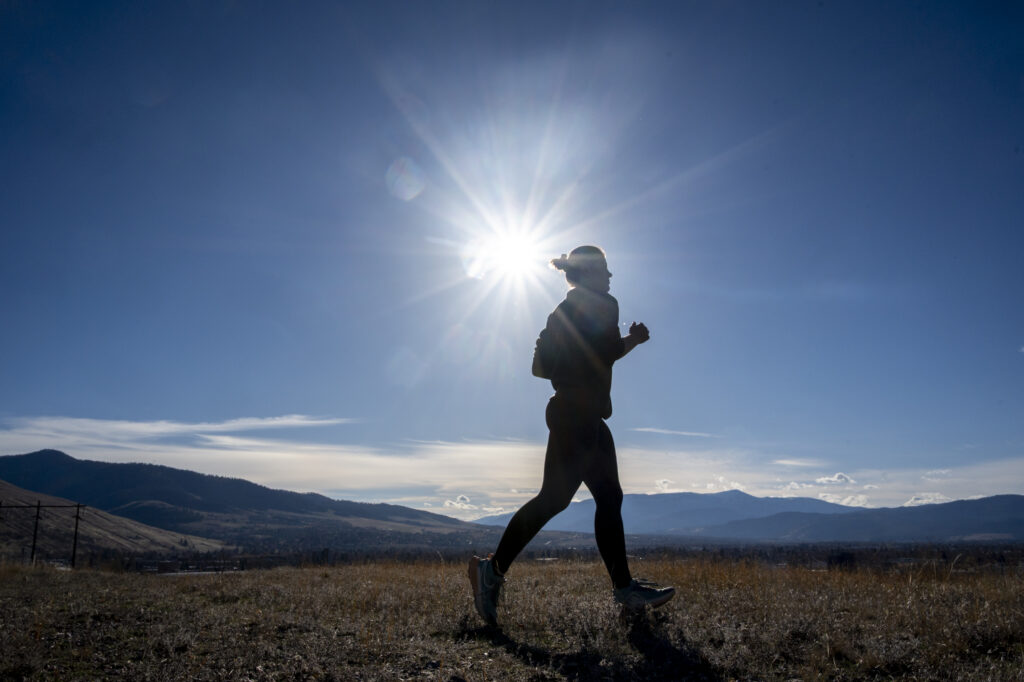
Missoulian Ellen Loran runs on Waterworks Hill on November 11, 2025. Loran runs two to three times a week unless she gets set back during the Montana smoke season.
Story by Douglas Lautzenheiser // Photos by Sydney Emond
It’s August in Missoula. The sun beams down through a murky gloom of smoke tinting the sky slightly orange. Ellen Loran is normally an avid runner, but not today. Today she is a hider. She’s obscured herself from the world, making sure to limit her exposure to the smoke that sits heavy in her lungs and makes it hard to breathe.
“Typically if it’s smoky outside I close up all the windows and try to regulate my activity outside,” Loran said.
Checking the Missoula County smoke guidelines before her afternoon runs are a must. Dense, smoke-filled air is a sign to stay indoors. A run on the treadmill beats a day full of smog that lingers in her chest through everything she does.
“I’m stuck inside,” Loran said. “The only way to keep it from really getting to me mentally is to just keep moving, but indoors.”
Loran is a chemistry student at the University of Montana and a lifelong Montanan. Living through the smoky Montana summers hasn’t always been easy, but for her, it’s all she’s ever known.
Like 28 million Americans, Loran has asthma. For people like her the realities of Montana’s annual smoke season can hit hard. Wildfire smoke’s toxic make up of microparticles causes potentially life-threatening health issues for people all across the Northwest. Current climate trends have created longer and more intense fire seasons, with no end in sight for people like Loran.
“I think I developed it as a child,” she said. “I always had a little bit of exercise-induced asthma, but when I was probably five-ish, I got diagnosed and have been using an inhaler ever since.”
There are several demographics that are particularly vulnerable to health risks associated with wildfire smoke. These include children, the elderly and people with pulmonary and respiratory issues like Loran. According to Climate Smart Missoula, one in three Missoulians are particularly susceptible.
What makes wildfire smoke so dangerous is its makeup of harmful gasses and particles. Especially troublesome is fine particulate matter known as PM2.5. These particles are smaller than 2.5 micrometers and penetrate deep into the lungs causing inflammation, breathing trouble and illnesses like chronic obstructive pulmonary disease.
Air quality guidelines have been adopted by many organizations across the nation in order to gauge the potential risks of prolonged activity in smoky air. These guidelines use PM2.5 readings to lay out when and for how long it is safe to be outdoors. Separate guidelines exist for at-risk subgroups who may have smaller or decreased lung capacity.
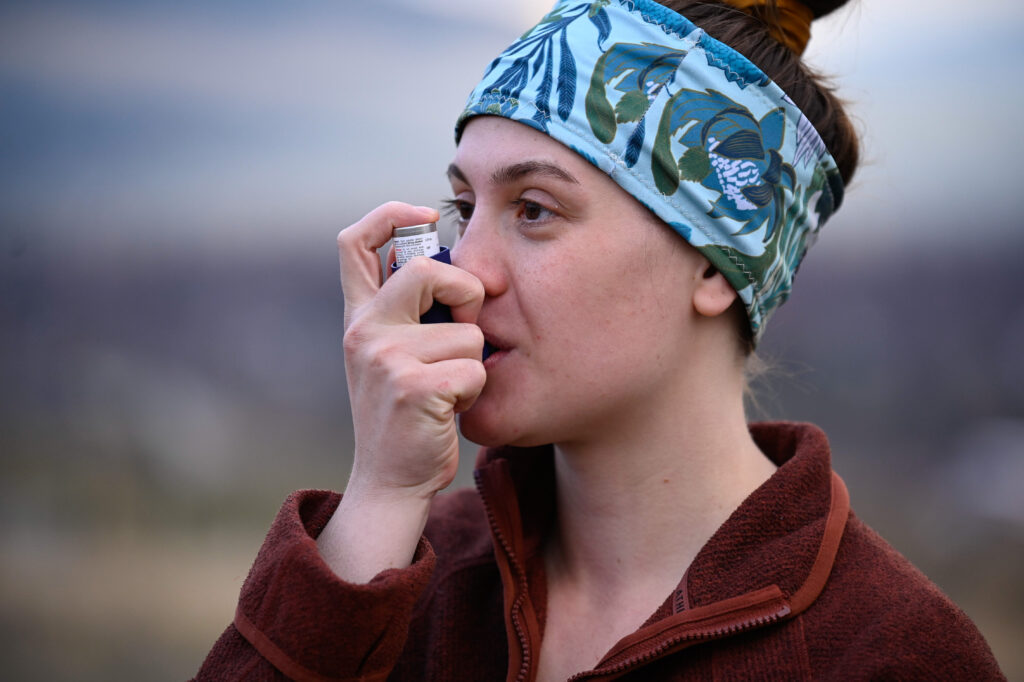
Loran uses her inhaler before her run on Waterworks Hill on November 16, 2025. Loran uses her inhaler during smoke seasons in the Missoula Valley as well as during the dry winter.
On the outskirts of a controlled burn in Lubrecht Experimental Forest, Wade Permar and Lu Tan take readings in the University of Montana’s mobile smoke sampling lab. The heavily modified Ford camper van has been outfitted with an assortment of computers, sensors and gauges.
“Behind you is a mass spectrometer,” Permar explains. “The spectrometer measures volatile organic compounds, so we can measure about 160 plus different VOCs in real time.”
Permar is a researcher at the University of Montana and the one in charge of the mobile lab. Graduate student Tan takes readings while Permar sits in the driver’s seat overseeing the calculations.
“The van came from the Smartfires project which is a grant program working with a couple of different Montana universities to better understand fire and its effects on air quality,” Permar said.
Permar and his team don’t take readings for any guideline-oriented organization. Rather, the mobile lab’s readings are used in studies related to wildfire smoke research being done at the University of Montana. Toxicologist Chris Migliaccio uses the data as he researches environmental exposures and their effects on the immune system.
Migliaccio works in a cramped office in the basement of the University of Montana’s chemistry building. He explains his fascination with his chosen field of study.
“Basically anything we breathe in I’m interested in how it affects the lungs, especially the immunity of the lungs,” Migliaccio said. “Over the past 10 or so years I’ve gotten more and more focused on wildfires just because it’s something we deal with every day.”
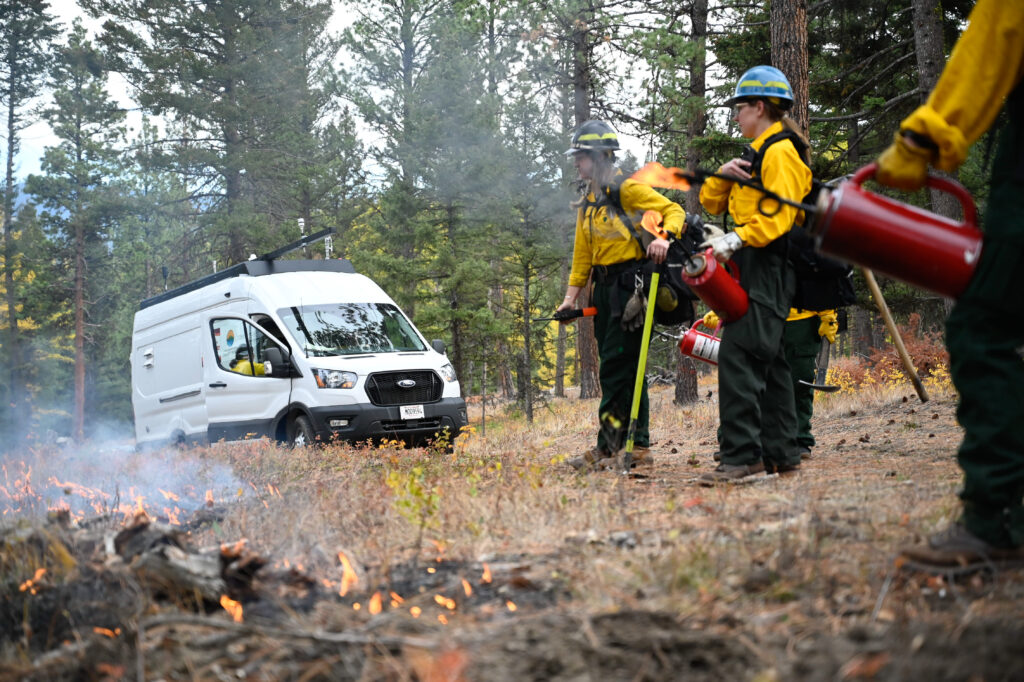
Lu Tan, a Ph.D. student at the University of Montana, climbs into the mobile chemistry van during a prescribed burn at Lubrecht Experimental Forest on October 24, 2025.
In 2017, Migliaccio headed up an effort to assess residents affected by the Seeley Lake fires. The research focused on residents rather than firefighters, a decision Migliaccio explained as being about collecting an even and consistent dataset.
“Firefighters come and go from an area,” Migliaccio said. “We ended up just focusing on community members because they were being exposed to these crazy levels of particulates.”
The study would run for three years with Migliaccio and his team returning each year for follow-up examinations. The team looked at how macrophages in the lungs broke down at the cellular level after exposure to high levels of PM2.5s.
Despite the COVID-19 pandemic cutting the human study short, Migliaccio says his team has been able to continue their research through using mice as test subjects.
“We translated [the Seeley study] to mice,” Migliaccio said. “Obviously the lifespans are very different, but we are able to control the amount of smoke they are exposed to and focus on the immunity of the cells in their airway.”
Migliaccio’s research aims to study the long term health effects of wildfire smoke exposure among various age groups.
While Migliaccio’s research continues, the fight for clean air knows no rest. At the forefront of the effort stands Climate Smart Missoula and its effort to give away as many portable air purifiers as possible.
In the small basement of a house-turned-office, Executive Director Amy Cilimburg holds up a simple box fan with an air filter neatly taped to the back.
“It’s a little more DIY, a little cheaper and the filters don’t last quite as long,” Cilimburg said. “But these are really good in a pinch, or again if you don’t have the resources.”
The non-profit is dedicated to climate education, advocacy and outreach in and around Missoula.
“Part of the way we operate is by asking what’s not happening in our community? What could we do? What’s really missing? And when we first were getting started no one was really talking about wildfire smoke.”
For Cilimburg and her team, what was missing was an effective program to get air purifiers into the hands of those who otherwise couldn’t afford them.
In a 2025 study, the National Collaborating Center for Environmental Health found that the use of an air filtration system during a combustion-related air event can reduce the amount of pollutants indoors by more than 56%.
Cilimburg estimates they’ve been able to give away several hundred portable high-efficiency particulate air cleaners over the organization’s 10 years of service.
“Nobody is immune to the impact of smoke,” Cilimburg said. “We’ve come to understand it’s not about going inside, but making sure you come into clean air.”
Climate Smart distributed filters to several schools and day cares across Montana. Before air filters were more widely adopted during the COVID-19 pandemic, Climate Smart ensured that schools with at-risk children and staff had clean indoor air.
Missoula County Public Schools nurse Lisa Flanagan serves students at Paxson Elementary School in Missoula. She explains that school-aged children facing respiratory issues such as asthma have learned to adapt to the smoky seasons.
“The ones that know they have this problem can often tell when the air is smoky and adjust their play around that or don’t go outside at all.” Flanagan said.
Some MCPS schools offer indoor play during wildfire season to combat smoke exposure. While this helps to keep children safe, Flanagan says that the lack of adequate play time can cause issues in the classroom.
“What we’re seeing is that when these kids don’t get a chance to run off all this extra energy they have then there begins to be behavioral issues and outbursts in the classroom.”
What manifests as outbursts for small children, comes as mental anguish for adults such as Loran. She describes it as a form of seasonal depression. The kind that makes it hard to get out of bed, hard to exercise, hard to engage in the hiking and running she holds so dear.
It’s fall now, gone are the embers of summer which stain the afternoon sky hues of yellow and orange. For Loran, that can only mean one thing: freedom.
She laces up her running shoes, the only real protection she now needs from the outdoors. Opening the door, she steps outside into air that is cool and clear.
It’s a new day and a less smoky one at that.