“Forest Fire Aftermath, 1910 – Wallace, street view [03]”, The Big Burn Collection, University of Idaho Library Digital Collections.
“Living with fire suggests that fire is this force outside, and it’s a potential threat. We can’t eliminate that threat, but we can learn to live with it.”
– Stephen Pyne
Story by Fiona Davia // Photos by Noah Epps
Thunder and lightning shook the small town of Wallace, Idaho, on Tuesday, July 26, 1910. By the end of August, snow was softly falling on the smoldering bones of its valleys.
The spring and summer of 1910 in the Northwest was uncharacteristically dry. The lack of rainfall could be heard as the wind blew through the land. The newly constructed Chicago, Milwaukee and Puget Sound Railway sprinkled red hot cinders into the dry forests as it went along. Historically roaring rivers and flowing streams were hushed to a whisper.
When a promising storm finally came, rain did not meet the Bitterroot Forest. A dry lightning storm ravaged the wilderness, placing embers beneath the dirt. Over the next month, a mosaic of thousands of fires sprang to life in the Northern Rockies.
On August 20, frigid western air bellowed towards the mountains. The hurricane speed winds fanned the smoldering fires, breathing life into them.
Within the next two days, more than 3 million virgin acres would be reduced to ash.
The fire of 1910 devastated the Northwest and forced the nation’s attention to wildfire. The aftermath led to an era of full suppression, where every fire was fought to extinction. The forces that govern fire — weather, topography and fuel — remain unchanged, while people move deeper into the landscape that fire has dominated for centuries.
Towns across Washington, Idaho and Montana were nearly leveled in the fire of 1910. A third of Wallace was consumed by the flames, the bulk of the destruction occurring in just six hours. The entire east end was left in ash to blow away with the wind.
Wallace, a mining town, sat tucked in a narrow crease of the Bitterroot Mountains. Valleys rose like walls on every side, thick with pines, western larch and douglas fir. Their dry needles carpeted the forest floor. A single rail line snaked through it. The town’s buildings stood proudly shoulder to shoulder, unaware of the destruction to come.
It was clear as the fire storm approached Wallace that the town would burn. Mayor Walter Hanson urged all women and children into trains to evacuate the doomed town and ordered the able-bodied men to fight. The chaos and fear in the air were palpable. Panic led to men fighting for spots on the train as townsfolk heard death approaching.
A collage of valiant men banded together to form a human fire line. Jail cells opened and people prayed as the hot wind pushed a continuous stream of sparks and debris toward Wallace. An ember fell near buckets of press grease and the Wallace Times exploded into flames, beginning the town’s demise.
Ranger Edward Pulaski was a seasoned woodsman. He grew up surrounded by trees and worked as a miner, railroad worker and ranch foreman before joining the Forest Service in 1908. The agency was young, underfunded and stretched thin. Rangers were expected to cover an overwhelming mileage on horseback, often alone. He knew every trail, ridge and creek that surrounded Wallace.
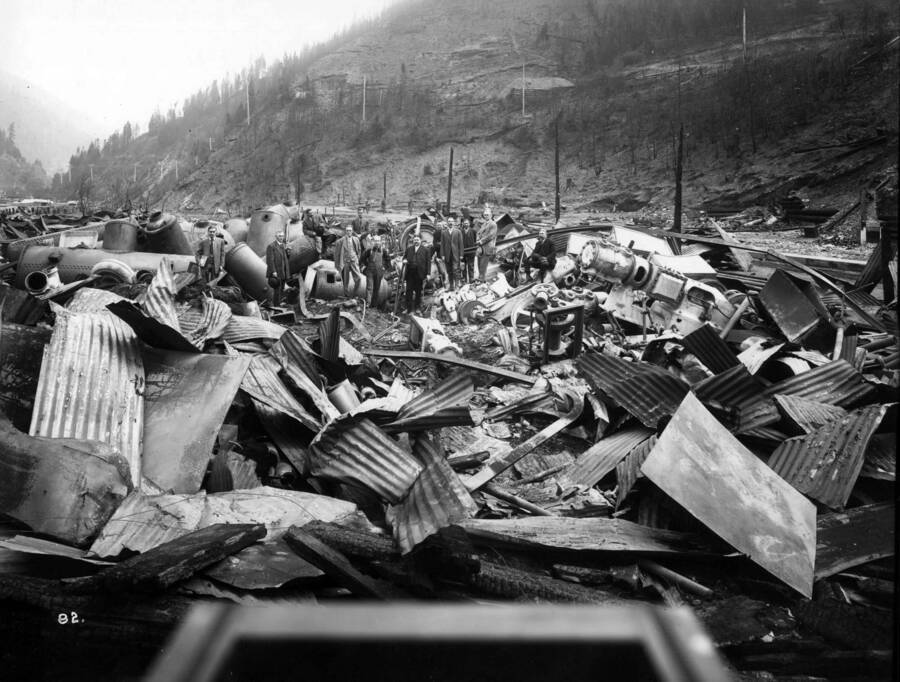
Forest Fire Aftermath, 1910 – Coeur d’Alene Hardware warehouse ruins, Wallace [01]”, The Big Burn Collection, University of Idaho Library Digital Collections.
Pulaski had spent the month of August trying to knock down the small fires simmering in the mountains. The night before Wallace fell, he came back with a warning for his wife to flee with their daughter — for Wallace would surely burn.
When fire converged on the town, Pulaski realized he and his crew were trapped. With fire bearing down from every direction, he ordered his 45 men to follow him. They stumbled through smoke and falling ash as their world was reduced to a choking blur of brilliant orange.
Pulaski brought his crew into an abandoned prospector’s mine and buckled down. He stood guard at the entrance, revolver drawn, warning that any attempt to flee would be a swift end. Hours passed as they lay in the dark, choking on heat and smoke as the storm raged on. Pulaski managed to save all but six of his 45-man crew.
On the night of August 23, rain sprinkled the ground turning to snow in higher elevations, the destruction had finally come to an end. The fire claimed the lives of roughly 87 people, most of them firefighters.
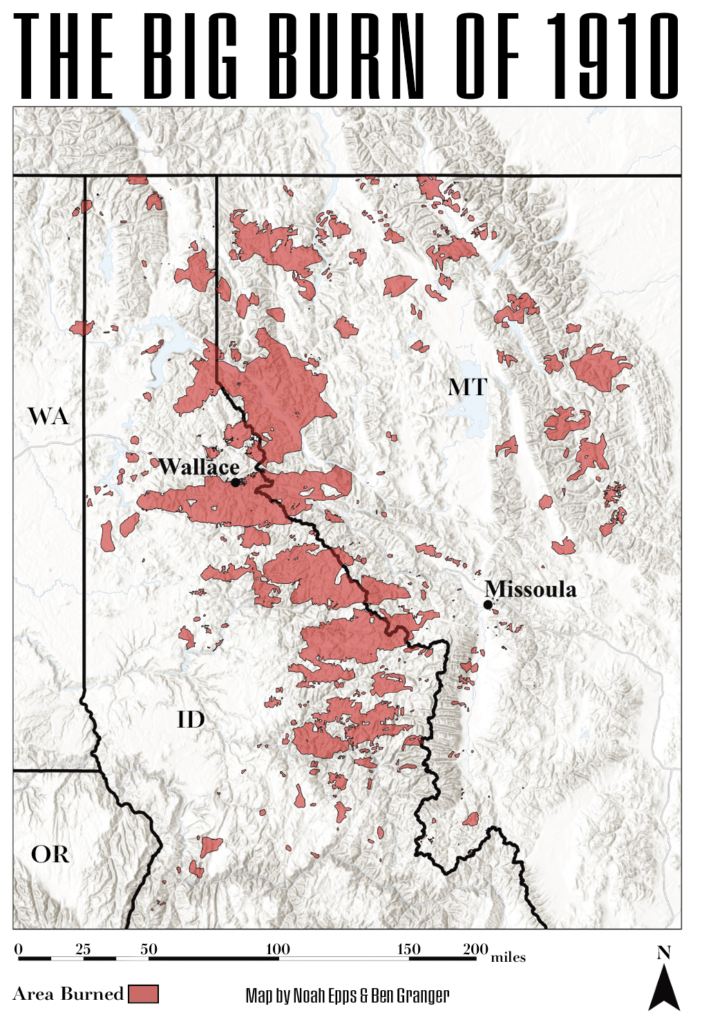
The devastation shook the Northwest and the rest of the nation. The U.S. Forest Service was still in its infancy, barely 5 years old and untested.
Stephen Pyne is an emeritus professor at Arizona State University, a prolific author and a leading historian of wildfire. He spent 15 seasons as a wildland firefighter for Grand Canyon National Park; 12 of those as a crew boss and one as acting fire officer.
Pyne calls the Big Burn America’s fire origin story. “It was a turning point for several reasons,” Pyne said. “The main one is that it occurred on land for which the newly established Forest Service was responsible.”
The Forest Service was shaken fighting the flames according to Pyne. “The agency was traumatized by it,” he said. “The chief of the forest service at the time, Henry Graves, had just assumed office in January.” The Forest Service built their identity around fire suppression, and every flame was now a threat. “It became a central expression of what the agency did,” Pyne said. “Can the agency do what it says? It identified all kinds of fire as a major problem.”
By 1935, the agency adopted a policy stating every fire, no matter the size or location, would be contained by 10 a.m. the morning after its report. This was called the 10 a.m. rule. Decades of extinguishing every flame left the forests dense. Trees grew close together, brush thickened and dead wood piled up where flame once cleared it. The same valleys once cleaned by fire would now burn again, hotter, longer and faster.
“We realized by the early 1960s that trying to exclude fire was a bad idea,” Pyne said. “It made for worse fires, unhealthy, tinder-fluffed forests, uncontrollable fires and so forth.” The identity of the Forest Service began to shift as suppression turned to restoration.
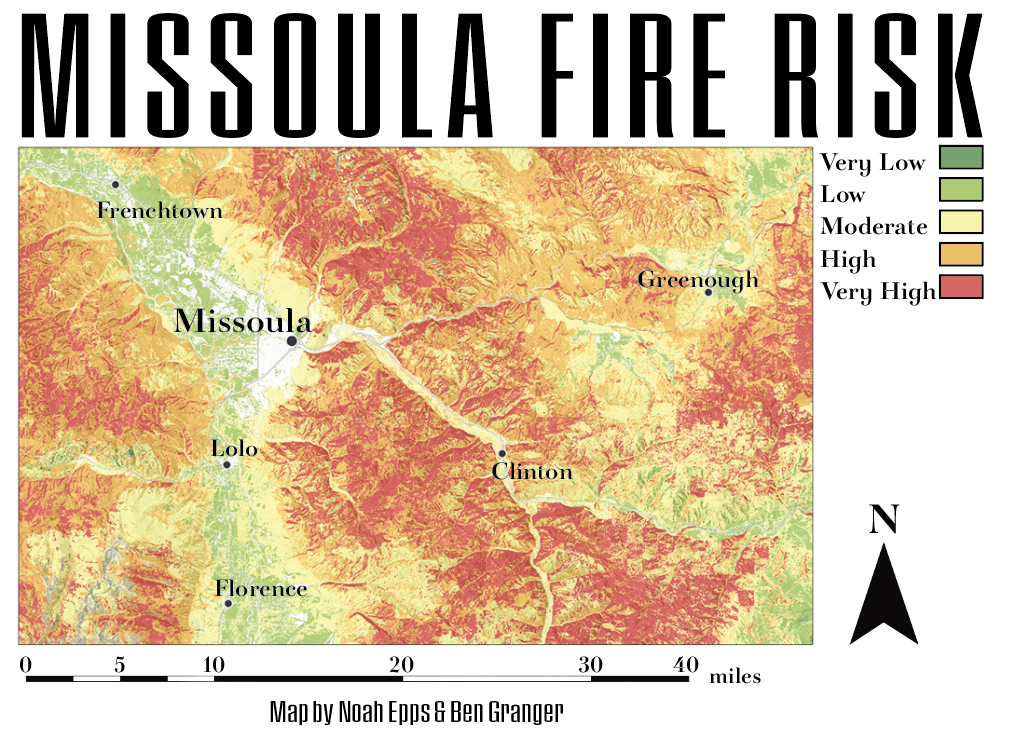
The landscapes that once burned now surround towns like Missoula, Montana, where the mountains cradle the city like a matchbox.
Missoula has long been at the heart of America’s fire story. On the west side of town lays the first operational smokejumper base, which later became the largest in the country and the primary training center for smokejumpers nationwide. Next to it, the Aerial Fire Depot hums through summer.
In 1960, the Forest Service’s Fire Science Laboratory was established. Researchers have spent decades using the lab’s wind tunnel, combustion chamber, fuels and emissions labs to better understand wildfire. Between the University of Montana’s fire science programs, the Northern Rockies Coordination Center and decades of accumulated practice, Missoula functions as a headquarters for understanding how to live with fire rather than simply fight it.
With summers lengthening, winters becoming shorter and dry periods that stretch deep into spring, the frequency of fire is increasing. Fire season is no longer isolated to a few anxious months. It’s a near-constant presence.
A study done in 2022 by the Environmental Protection Agency shows the area burned by wildfires has been increasing since the 1980s. According to data recorded by the National Interagency Fire Center, the 10 years with the largest acreage burned have all occurred since 2004. This coincides with many of the warmest years on record.
At the University of Montana, fire scientist Dr. Carl Seielstad studies how wildfires move through landscapes. A former hot shot and smokejumper, now a burn boss and researcher, Seielstad has spent more than 30 years combining the worlds of science and fire.
“I do think that it is becoming a more frequent occurrence that we see the kind of conditions aligned to create these real, significant events that we don’t forget for a long time,” Seielstad said. “The conditions that bring stress, heartache, changes in policy, expenditures and loss of life are happening at a faster pace and more of them.”
Seielstad explains that it is a probability game. During any given summer the chances for these rare events to happen is increasing. What once were extraordinary “perfect storms,” are now happening more regularly, often near populated areas.
Pyne situates these changes within a broader historical and human context. He sees modern catastrophic fires as both natural phenomena and products of human development. “These really horrific fires, not just big fires, the ones that are really doing these damages, running into cities and all the rest of it, have become a pathology of the developed world,” Pyne said.
He emphasizes that the current climate trends directly interact with human settlement patterns and amplify risk. “You’ve got to change how you live on the land, and that means changing what development means,” Pyne said.
Pyne frames this as part of a long-term, human-driven “fire age,” what some scientists call the Pyrocene. He describes it as the fire equivalent of an ice age, with the climate becoming a sub-narrative of fire history. “I think of it as a slow motion Ragnarök,” he said. “What has been legend is now becoming ecology. The world that comes back after these fires will be different than what existed before. It will be a world better adapted to fire.”
Together, these perspectives underscore a stark reality, climate trends are reshaping fire risk, but human choices, where we build, how we manage fuels and how we prepare communities, remain just as critical.
Missoula is one of the many western towns built in a place both beautiful and dangerous. It sits at the heart of five valleys, where mountain winds converge and rivers braid through grass and pine.
Over the past several decades, the edges of Missoula have stretched deeper into the pines. New homes have been built where forest meets field, the boundary known as the wildland-urban interface is growing thin.
According to research done by the U.S. Forest Service in 2020, nearly half of the homes across the northwestern states are now in this interface. In Montana, that number grows to around 62%. Each summer as the air turns dry and the horizons fill with smoke, those homes sit on the border between wilderness and civilization.
Seielstad knows this boundary well. For him, the interface isn’t just geography, it’s a collision of human optimism and natural inevitability. “Those urban conflagrations,” he said, “are now coming from a single fire that starts approximate to a city or an urban area and under really dry, windy conditions. That fire gets up and rolls into a community with a head of steam, very fast.”
Missoula’s south hills rise like kindling, slopes of cured grass leaning with the dominant winds. “Pattee Canyon is exposed,” Seielstad said. “If fire started in the canyon on a dry windy day, it would move right up into Deer Creek. Fast.” The same pattern repeats across the city’s edges: Grant Creek, Butler Creek and the Rattlesnake. “The most likely places for a fire that really impacts the city would be in these appendages,” he explained.
“The thing that moves fire through town is the wind,” Seielstad said.
Fire follows weather, topography and fuel, a simple equation wrapped in chaos. “The urban area isn’t inherently flammable the way the wildlands are,” he said. “Fire needs to find its way into the nooks and crannies of parts of the urban environment that are receptive. Once it gets into those things, it can consume whole structures.”
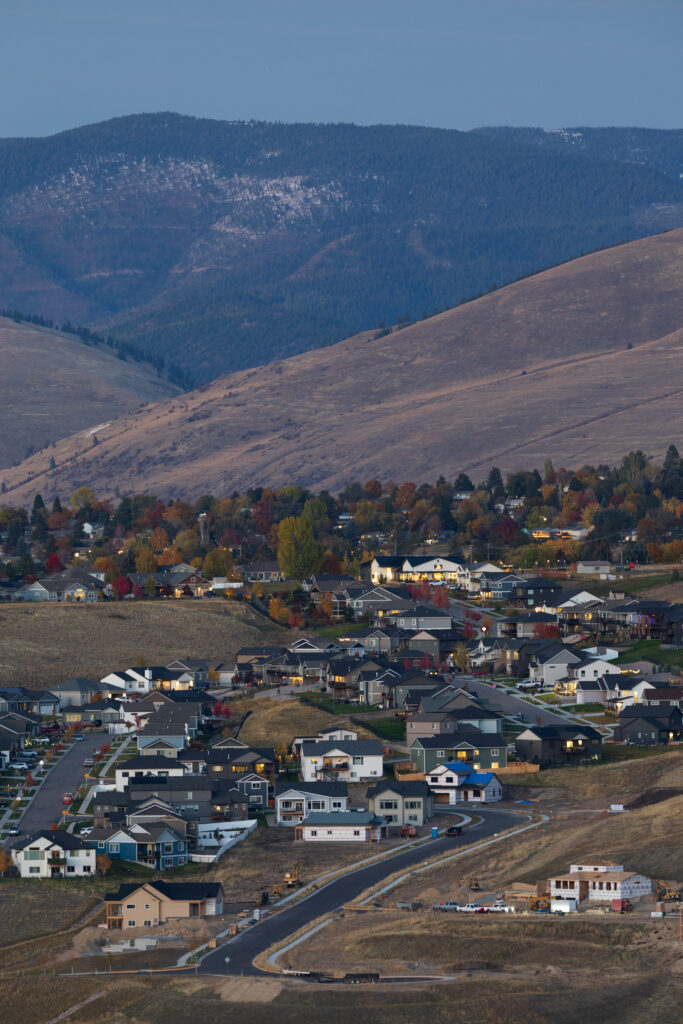
Missoula’s outward expansion can be seen in the development of the Miller Creek neighborhood as new houses are built and roads are extended further into the wildland urban interface on October 21, 2025.
Dry fuel, low humidity and a storm blowing in from the wrong direction are a perfect combination for disaster. “Anybody who pays attention to fire,” Seielstad said, “doesn’t kid themselves that we’re just a series of coincidences away from 1910 happening again.”
Seielstad explained that while most people understand, at least in theory, that fire is part of the western landscape, they often underestimate how quickly it can reach them. “I don’t know that their idea of what would happen or what could happen is very well conceived,” he said. “But in terms of general awareness, there is some exposure that they have.”
As a historian, Pyne has seen how culture often lags behind ecology. “Most people are willing to understand that there could be good fires, in the same way that they can understand a place for wolves,” he said. “They just don’t want them bothering their kids on their way to school, they don’t want them right next to their house.”
For Pyne, the issue isn’t just wildland fire, it’s how communities prepare for the inevitable. “This is not a wildland fire problem,” he said. “It’s an urban fire problem, and you need to organize and harden your communities accordingly.” Pyne believes that progress depends less on controlling nature and more on adapting the built environment to live alongside it.
Seielstad recognized that public perception has shifted faster than policy. “We’re certainly talking about it now. The message that I think everybody now is aware of is that fire has benefits and we’re not going to remove all of it,” Seielstad said.
But the system itself, he noted, still defaults to suppression. “This summer was a very benign fire season, and we just went crazy with our fire management activities. We spent $55 million on a 6,000 acre fire. That’s not behaving in a way that is thinking that fire is something we have to live with. And that’s not an exception, that’s just kind of the way we do things still.”
The tension between understanding fire in theory and living with it in practice becomes clearest in the fringes of Missoula, where many call the interface home. For them, fire isn’t an abstract policy issue or scientific model. It’s a season that returns every year, carried on wind and heat, testing the boundary between comfort and vulnerability.
Tucked in the Bitterroot Valley and framed by the Bitterroot River lays the home of Bart and Wendy Morris, the co-owners of Oxbow Cattle Company. The pair moved to Missoula in 2006 and started their ranching company eight years later. The Morrises own a total of 245 acres along Miller Creek near Missoula and lease approximately 4,500 acres across the valley to graze their cattle.
Living in Missoula’s expanding appendages has meant watching the city push steadily toward Morris’s fencelines. “The city of Missoula, as soon as it hits our fences, that’s kind of where it stops,” Bart Morris said.
When they moved to the valley nearly 20 years ago, the neighborhoods near their land were separated by pockets of open land. “They were like islands,” he said. “But now it’s all filling in.”
With that growth has come more people, more activity and in Morris’ opinion, more opportunities for accidental ignition. “The more people you have just increases the odds,” Morris said. “Their chain comes off and sparks on the pavements and causes a fire, someone throws a cigarette out of the window, or on the Fourth of July, they shoot fireworks where they shouldn’t be shooting fireworks.”
Fire is no stranger to the Morris family. “We’ve seen it come and go for sure,” he said. Over the years, they’ve seen flames burn through two of their leased pastures and one of their owned properties.
“By July, we have some pretty big tinder boxes around that could burn up pretty fast,” Morris said. “We’ve been fortunate enough to not have that happen. But we’re constantly grazing too, so we’re knocking down fire hazard through our grazing.”
A bad fire season would be more than a threat to their home. It would damage their business. “We could lose all of our stockpiled forage for that year,” he said. “We’d have to buy hay or sell cows.”
“It was a September lightning strike,” Morris said. “We heard it, I had the windows open so I could smell smoke instantly.” The fire lit up the night sky and pushed north toward their property. “Had the wind kept going, it would’ve been a different story,” he said. Fire crews staged their camp on their property and got the fire under control by the next morning. “Our house and barn are defensible because we irrigate around them. But some folks live right in those trees. It would’ve been more of a challenge to defend their places.”
What worries Morris most is the growing human presence in these once-rural areas. “The amount of people we live next to, that’s the vulnerable thing. When it gets to be a tinder box in July, August and September, we’re not having lightning starts, but we always have the human factor.”
He explained that there has always been fire in these places, but there weren’t always homes. “It’s encroaching where people haven’t lived in the past, and anytime you do that you’re more vulnerable,” he said.
Despite the risk, he refuses to live in fear. “If you worry about fires, you also have to worry about blizzards and floods,” he said. “Where we live, our business is dictated by the elements. So, we just take it as it comes.”
To Morris, fire still has its place in Missoula’s conifer-choked foothills, but it rarely gets the chance. “Fires don’t get to do what fires used to because of the human aspect,” he said. If a fire is allowed to burn and something goes wrong, agencies face lawsuits. That pressure pushes them toward more aggressive suppression. “When you work with Mother Nature, you have to understand that if you try to push against her, you try to control it, she will just make a laughing stock of you.”
For the couple, living in the interface means accepting that risk is woven into the landscape, shifting with the weather, the wind and the choices of the people who now call this once unpopulated valley home.
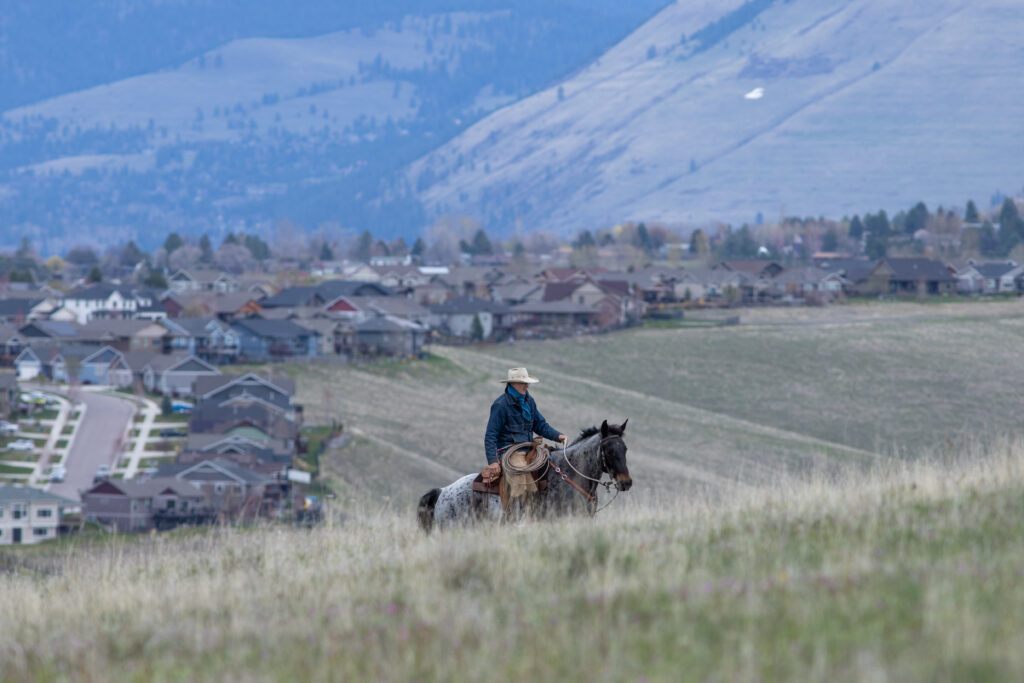
Bart Morris of Oxbow Cattle Co. guides his cattle on horseback to a larger pasture on their Miller Creek ranch just outside of Missoula, Montana, on April 20, 2025.
“I’m trying to reformulate living with fire to making fire a part of living,” Pyne said. “Living with fire suggests that fire is this force outside, and it’s a potential threat. We can’t eliminate that threat, but we can learn to live with it.”
Pyne claims learning to make fire a part of living is a familiar concept. “Fire is a companion,” he said. “It’s something we work with. It’s not just a tool or an ecological practice. This is something humans have had with us all our existence as a species. We’re the only species that does it. And we’ve turned our best friend into our worst enemy.”
More than a century after the Big Burn, fire still shapes how the West defines safety, community and loss. The same winds that once swept through Wallace now push smoke over Missoula’s hills each summer. What’s changed isn’t the danger but the understanding that fire will always return. The world is a place that was meant to burn.